The Integration of AI in Referee Decision Making for Football, Basketball, and Tennis Matches
Written by Gisela Richter · Aug 22, 2026
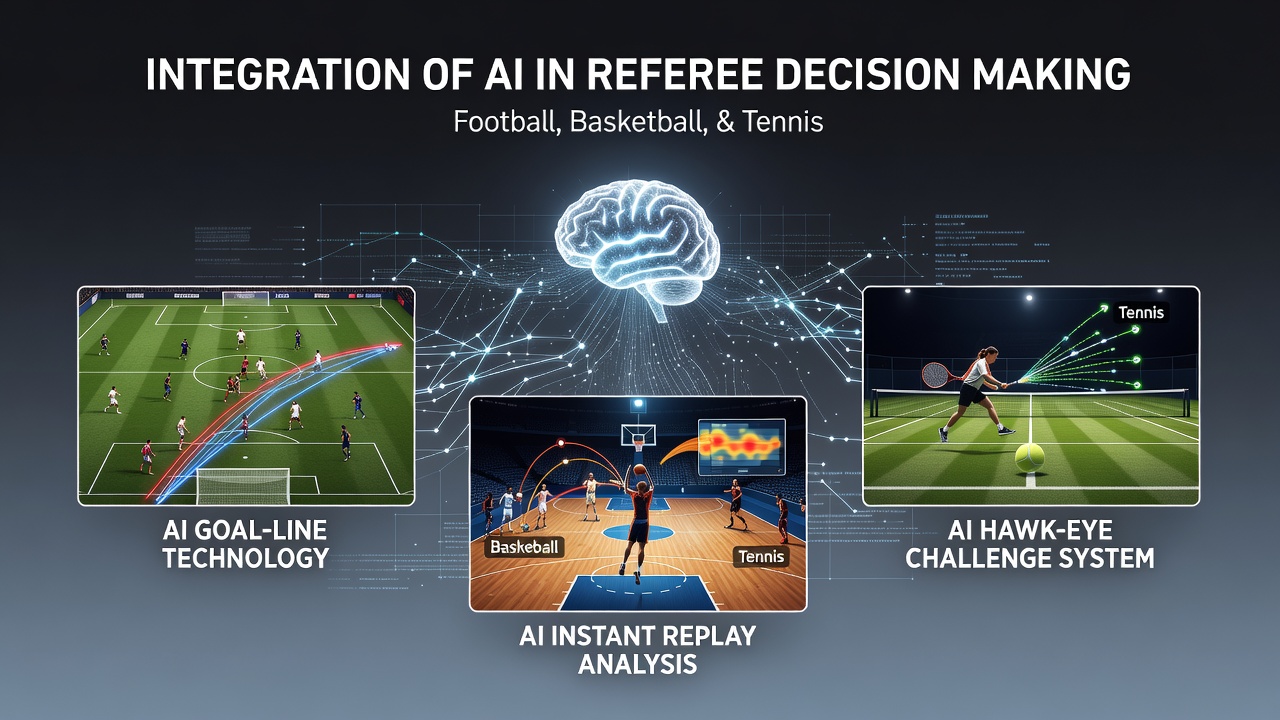
The Integration of AI in Referee Decision Making for Football, Basketball, and Tennis Matches
Artificial intelligence systems now assist referees across football, basketball, and tennis by processing real-time data streams that include player positions, ball trajectories, and movement patterns, and these tools have expanded steadily since their initial deployments in the early 2000s. Governing bodies continue to refine the technology to support faster, more consistent rulings while maintaining human oversight for final authority.
AI Tools in Football Officiating
Football federations adopted video assistant referee protocols that incorporate machine learning algorithms to flag offside positions and goal-line crossings, and the semi-automated offside technology debuted at major tournaments before broader rollout. Data from tracking cameras feeds into neural networks that calculate player limb positions within millimeters, which allows officials to review borderline calls without extended delays. In August 2026 the FIFA World Cup will feature updated AI modules that integrate multi-angle drone footage with existing pitch sensors, and this combination aims to reduce review times by an additional thirty percent according to technical specifications released by the organization.
Researchers at several European universities have published studies showing that AI-assisted systems decrease incorrect offside decisions by roughly forty percent compared with traditional video review alone, yet the same reports note that human referees still intervene when contextual factors such as player intent arise. Leagues in South America and Asia have begun licensing similar platforms, and early adoption data indicates consistent accuracy gains across varying stadium lighting conditions.
Implementation in Basketball Leagues
Basketball competitions employ AI-driven replay centers that analyze contact angles and release points during shooting fouls, and these systems overlay three-dimensional models onto live footage for review crews. The National Basketball Association expanded its use of such software in 2024 to include automated detection of traveling violations, and subsequent seasons have recorded measurable drops in disputed calls during regular-season games. Canadian and Australian basketball associations have tested parallel platforms that combine court sensors with overhead cameras, and results from those trials appear in industry reports issued by regional sports science institutes.
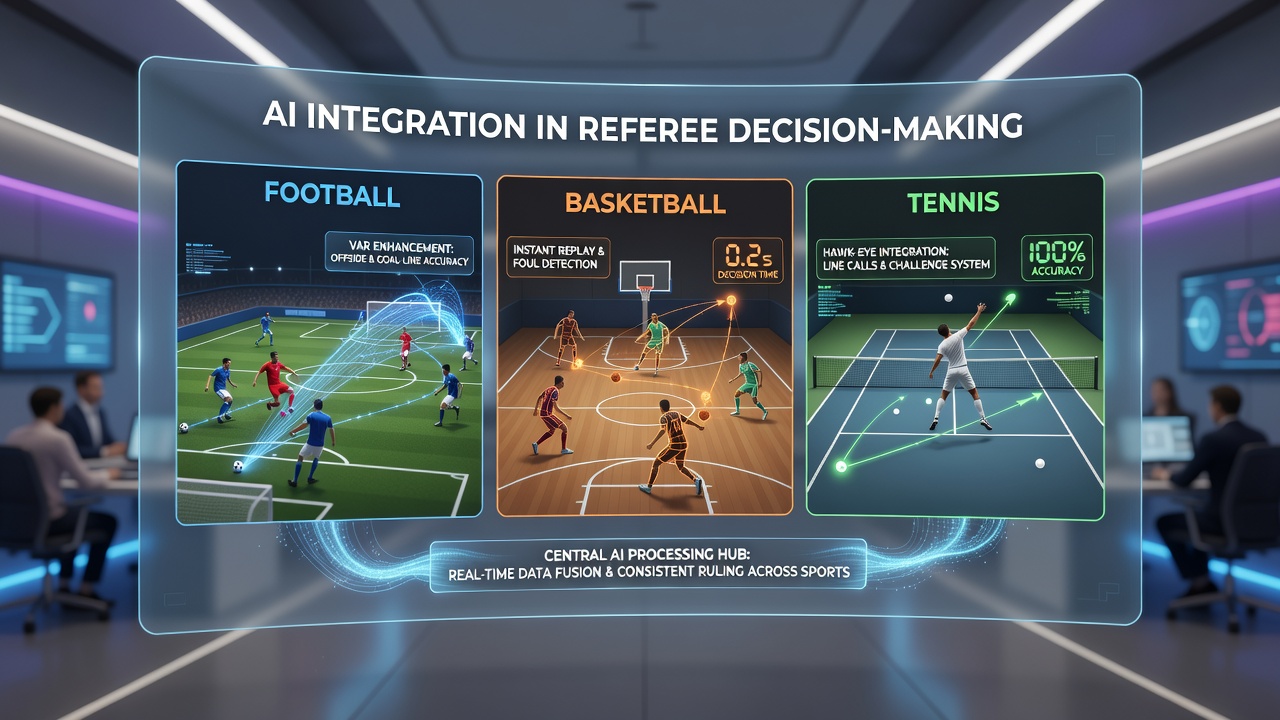
Coaches and players receive access to simplified versions of the same data sets after matches, which supports post-game analysis without altering in-game authority structures. Studies conducted by North American research centers indicate that the technology processes foul sequences in under two seconds, a speed that preserves game flow while supplying referees with objective measurements.
Tennis Line-Call Systems and Hawk-Eye Evolution
Tennis tournaments integrated Hawk-Eye technology more than fifteen years ago, and the platform now uses enhanced AI models that predict ball bounce locations with sub-millimeter precision across grass, clay, and hard courts. The International Tennis Federation updated its certification standards in 2025 to require multi-camera arrays that feed data into convolutional neural networks, and these upgrades have lowered challenge success rates for players because initial calls already align more closely with actual impact points. Grand Slam events schedule additional calibration checks before each session, and officials monitor system performance through live dashboards that flag any sensor drift.
Independent evaluations from Australian and Japanese sports research groups confirm that the revised algorithms handle high-velocity serves and spin variations more reliably than earlier versions, and the same evaluations document fewer than five incorrect challenges per thousand points played at elite levels. Players continue to retain a limited number of challenges per set, preserving an element of human judgment within the automated framework.
Shared Technical and Regulatory Considerations
Across all three sports the core architecture relies on synchronized camera networks, inertial sensors, and edge-computing processors that deliver outputs to centralized review rooms, and governing bodies maintain separate oversight committees that audit algorithm training data sets for bias. European Union sports technology guidelines emphasize transparency requirements for any AI model used in official competitions, while similar frameworks in other regions focus on data privacy protections for athlete biometric information. Training programs for referees now include modules on interpreting AI visualizations, and certification exams test both rule knowledge and system literacy.
Case examples from recent international events show that hybrid decision models, where AI provides an initial recommendation followed by human confirmation, produce the highest overall accuracy rates according to aggregated competition statistics. Technical failures remain rare yet prompt contingency protocols that revert to traditional video review until systems stabilize.
Conclusion
The integration of AI into referee decision making continues to evolve through iterative updates and cross-sport knowledge sharing, and current trajectories point toward even tighter coupling between sensor networks and officiating protocols by the end of the decade. Sports organizations track performance metrics from each season to guide further refinements, ensuring that technological support remains aligned with the fundamental requirement for fair and timely rulings.