Nutrition Timing Strategies That Shape Endurance Outcomes Across Cricket Test Matches, Tennis Grand Slams, and Rugby Union Tournaments
Written by Ines Hayes · Nov 5, 2026
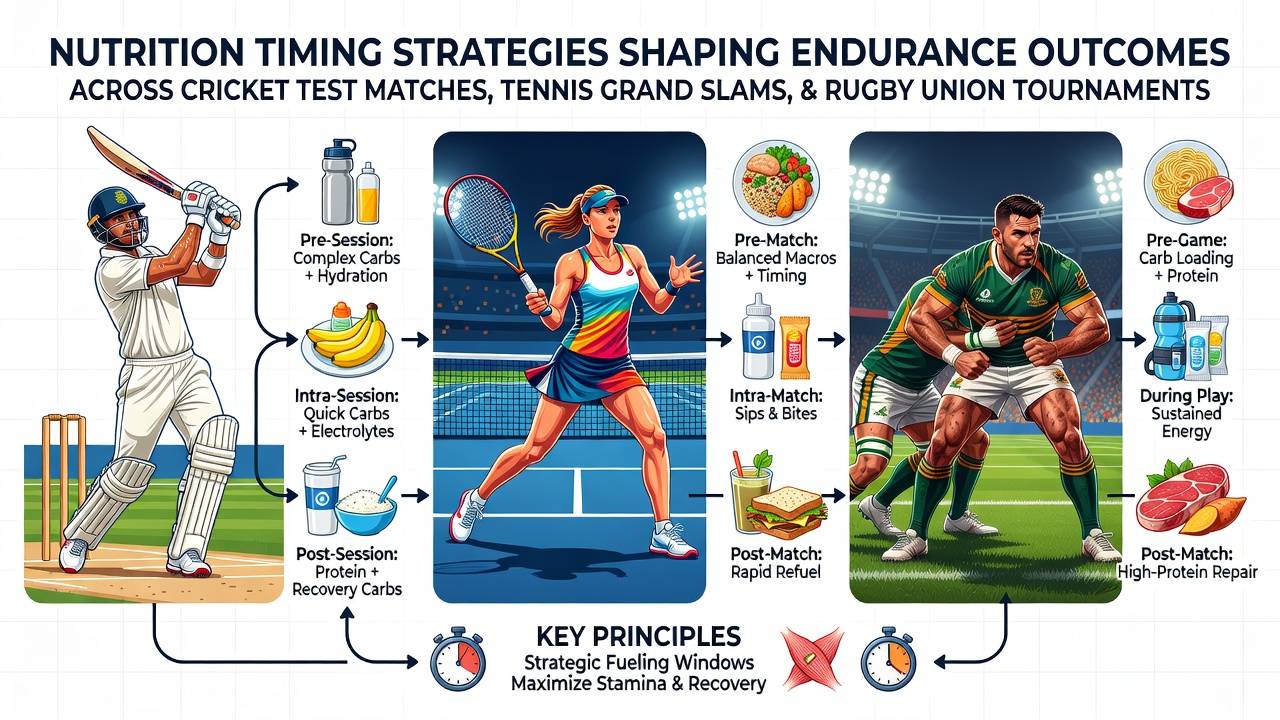
Nutrition Timing Strategies That Shape Endurance Outcomes Across Cricket Test Matches, Tennis Grand Slams, and Rugby Union Tournaments
Nutrition timing plays a central role in how athletes maintain energy levels during prolonged competitions, and researchers continue to map out specific windows for carbohydrate intake, hydration and recovery across different sports. In cricket test matches that stretch over five days, tennis grand slams that demand repeated high-intensity efforts across best-of-five-set formats, and rugby union tournaments that feature back-to-back fixtures with limited rest, the sequence and spacing of nutrient delivery directly influence glycogen replenishment and muscle function.
Carbohydrate Loading Windows Before Multi-Day Events
Experts at the Australian Institute of Sport have documented that athletes who begin carbohydrate loading 36 to 48 hours before a test match or grand slam opener achieve higher muscle glycogen stores than those who spread intake more evenly across the preceding week. This protocol involves increasing daily carbohydrate consumption to 8 to 12 grams per kilogram of body weight while simultaneously reducing training volume, which allows stores to peak without excessive fatigue. In rugby union, where tournaments often schedule matches every three or four days, teams apply similar pre-tournament loading but adjust portions to account for shorter overall duration per game.
Studies published in the European Journal of Sport Science show that timing the final high-carbohydrate meal three to four hours before match start maximises availability while avoiding gastrointestinal discomfort during the opening overs or sets. Athletes who consume this meal too close to start time report higher rates of nausea, whereas those who finish eating four hours out demonstrate steadier blood glucose throughout the first session of play.
Intra-Event Fueling Patterns
During extended play, the frequency of intake becomes critical. Cricket players typically ingest 60 to 90 grams of carbohydrate per hour through a combination of sports drinks, gels and bananas during drinks breaks, with research indicating that spacing these doses every 20 minutes prevents energy dips more effectively than larger boluses at longer intervals. Tennis competitors follow comparable hourly targets yet adapt delivery to changeovers, often using portable bottles and quick-dissolve chews that require minimal chewing time between points.
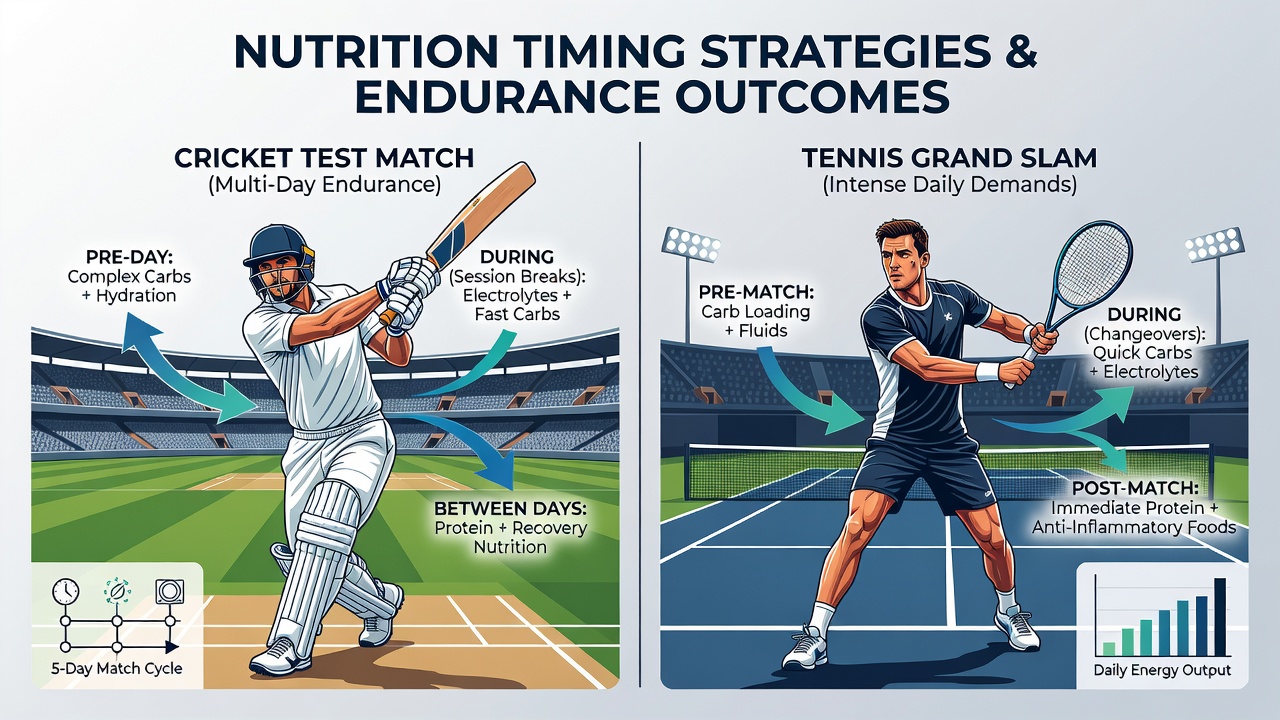
Rugby union athletes face additional constraints because matches last 80 minutes plus stoppages, yet recovery between tournament fixtures must occur rapidly. Data from the New Zealand Rugby Union performance unit reveal that players who ingest 1.2 grams of carbohydrate per kilogram within 30 minutes of final whistle accelerate glycogen resynthesis compared with those who delay intake until the two-hour post-match window. This early consumption also pairs with 20 to 30 grams of protein to support muscle repair before the next training session.
Hydration and Electrolyte Scheduling
Fluid intake timing interacts with nutrient delivery in all three sports. Cricket teams operating in hot climates schedule fluid breaks every 45 to 60 minutes and add sodium to drinks when match temperatures exceed 30 degrees Celsius, according to guidelines issued by the International Cricket Council medical panel. Tennis players monitor sweat rates during practice sessions weeks before grand slams and pre-load with 500 millilitres of electrolyte solution two hours before matches begin, then sip 150 to 200 millilitres every changeover. Rugby squads apply similar pre-hydration but incorporate sodium bicarbonate trials in training to buffer acidosis during high-intensity phases.
November 2026 schedules for several southern hemisphere rugby tours and Australian summer cricket series place additional emphasis on night matches, where circadian shifts alter both appetite and digestion; nutritionists therefore recommend lighter evening meals with faster-absorbing carbohydrates to maintain alertness without overnight gastric load.
Recovery Nutrition Between Sessions
Across all three disciplines, the two-hour window immediately after competition remains the most effective period for replenishing glycogen at rates up to 5 percent per hour when athletes combine carbohydrates and protein in a 3-to-1 ratio. Tennis players who compete on consecutive days at grand slams often consume recovery shakes within 15 minutes of match completion, followed by a balanced meal two hours later. Cricket support staff prepare post-play buffets that include both quick-release and slow-release carbohydrate sources to sustain overnight recovery during five-day tests.
Observers note that rugby union teams traveling across time zones during November tours adjust this timing by shifting meal clocks 24 hours in advance, allowing gastrointestinal adaptation before the first match. Those adjustments reduce reported instances of delayed gastric emptying that otherwise impair early-tournament performance.
Conclusion
Coordinated nutrition timing across pre-event loading, intra-competition fueling and post-session recovery consistently correlates with maintained power output and reduced perceived exertion in cricket, tennis and rugby union. Teams that align carbohydrate, fluid and protein delivery with the specific demands and rest intervals of each sport record measurable advantages in endurance metrics tracked by performance analysts. Continued refinement of these schedules, informed by ongoing physiological monitoring, supports athletes who face increasingly condensed tournament calendars.